

Warehouse Tent What You Need to Know Before Buying
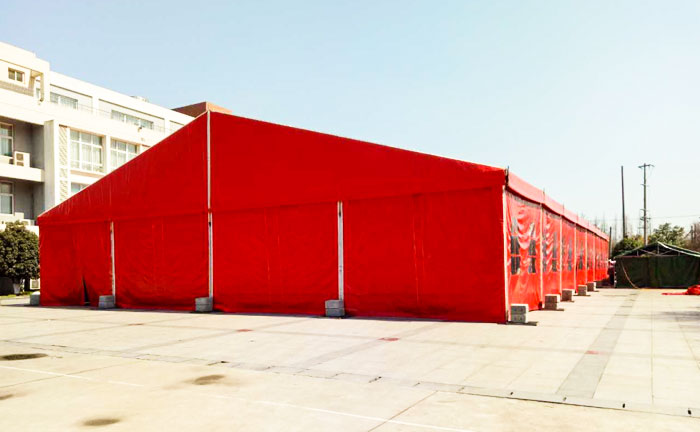
A warehouse tent is a modular, relocatable temporary structure. It uses an aluminum frame and a PVC fabric cover. Industrial buyers choose it for fast, cost-effective, column-free storage. Deployment typically takes 3 to 14 days. Small units under 500 square meters can be ready in one day. Large sites over 1000 square meters usually need 3 to 5 days.
This guide explains what a warehouse tent is, its benefits and limits, and how it compares with a traditional building. It also covers the key factors to evaluate before you buy. That includes size, foundation, climate needs, regulations, suppliers, and warranty terms.
Key Takeaways
Warehouse tents save 40-70% compared to permanent buildings.
You can set up a warehouse tent in one week or less.
These tents are flexible and can move or expand as needed.
Check size, foundation, and climate needs before you buy.
Choose a supplier with certifications and a good warranty.
What Is a Warehouse Tent?
Definition and Main Types
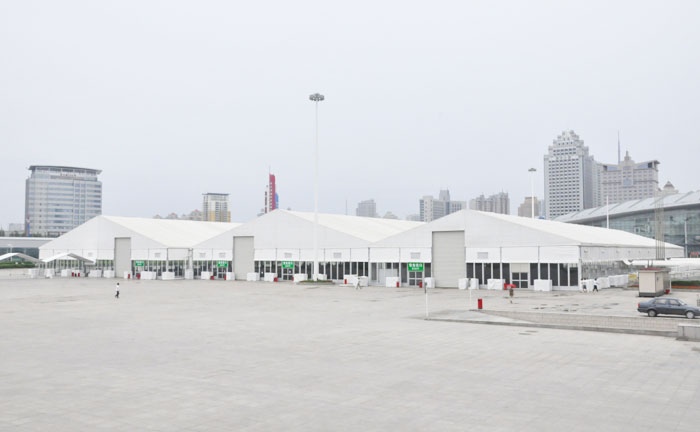
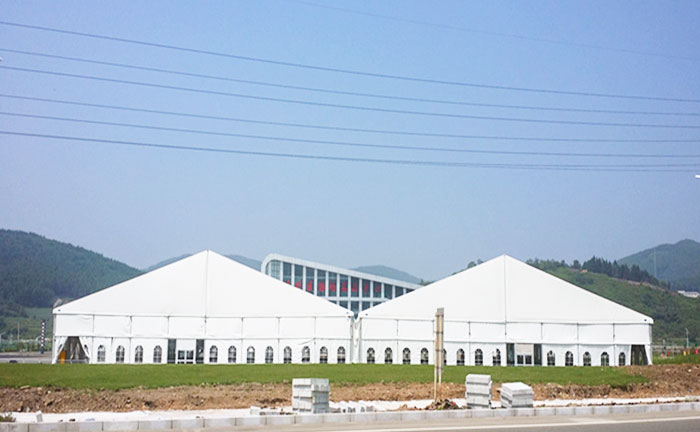
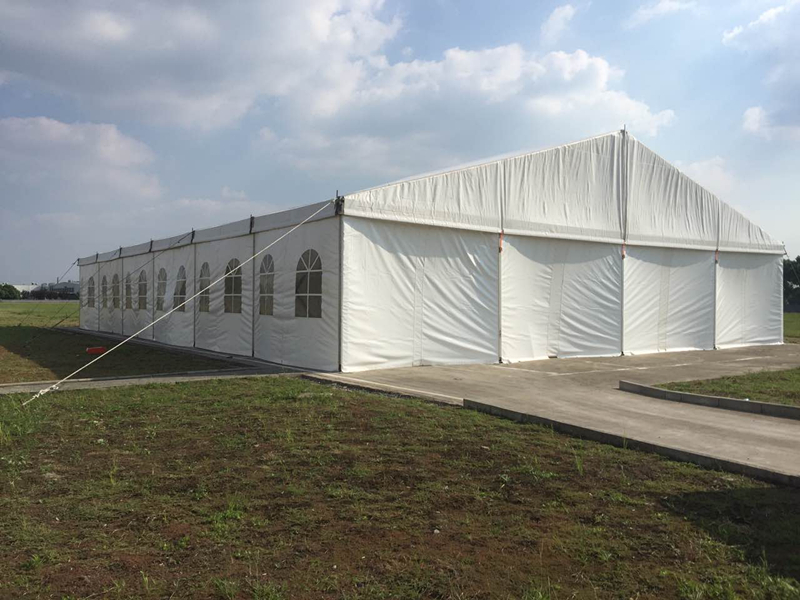
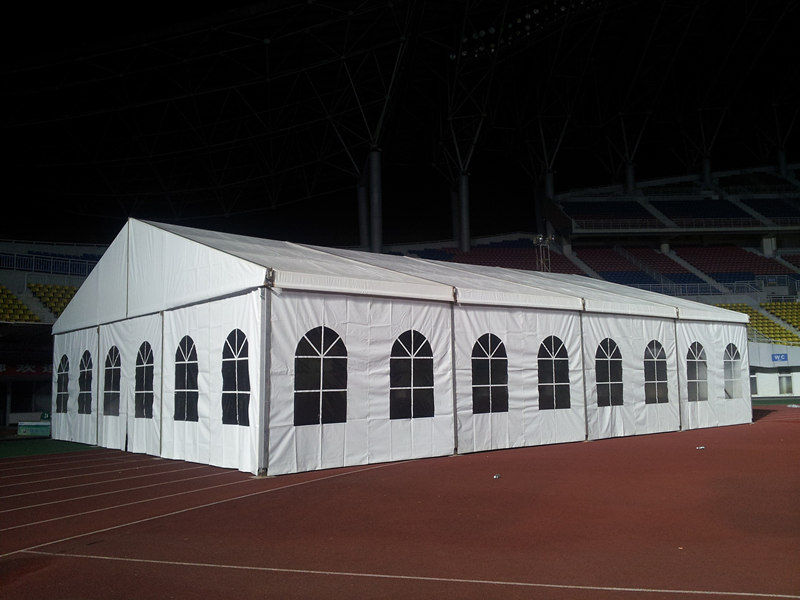
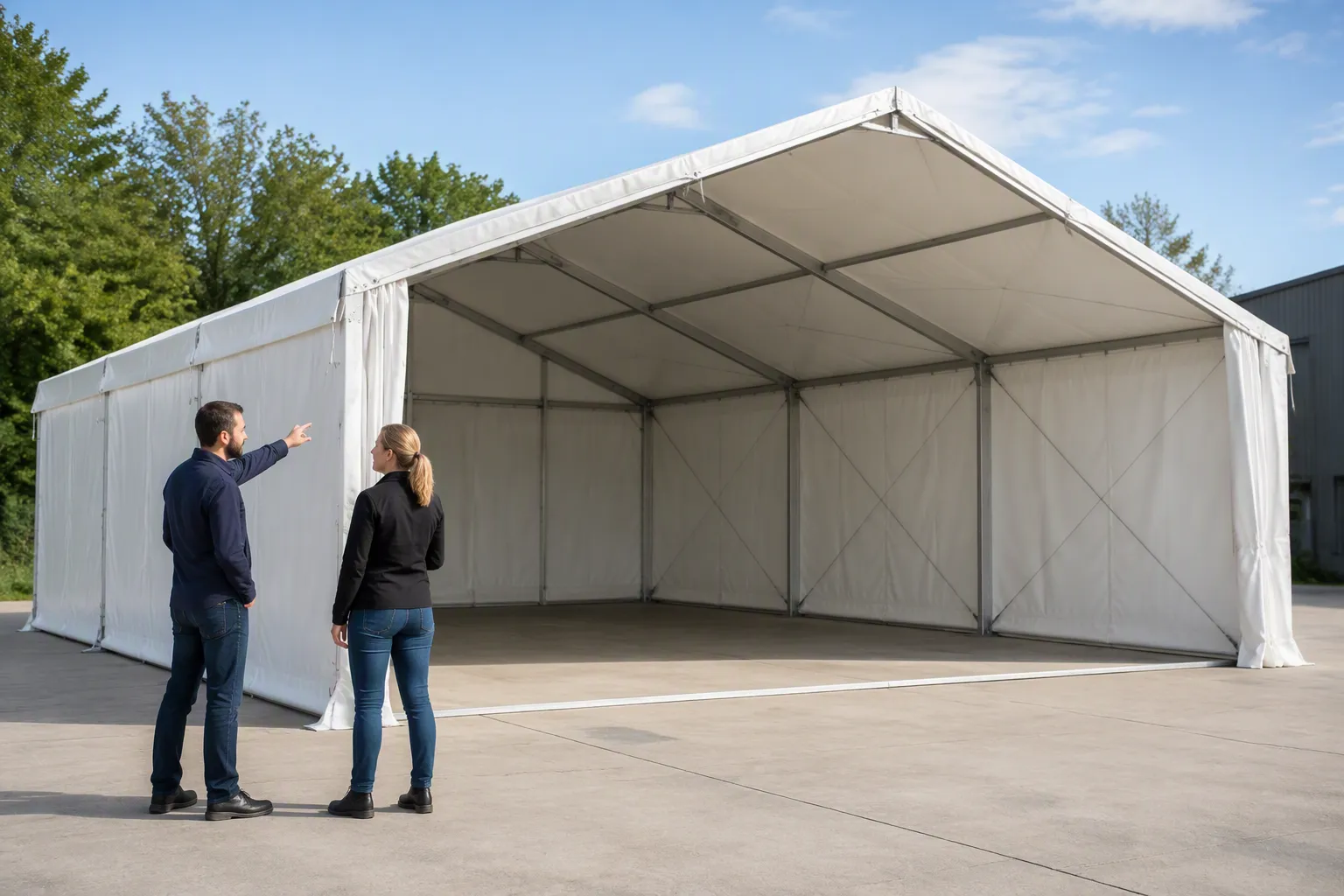
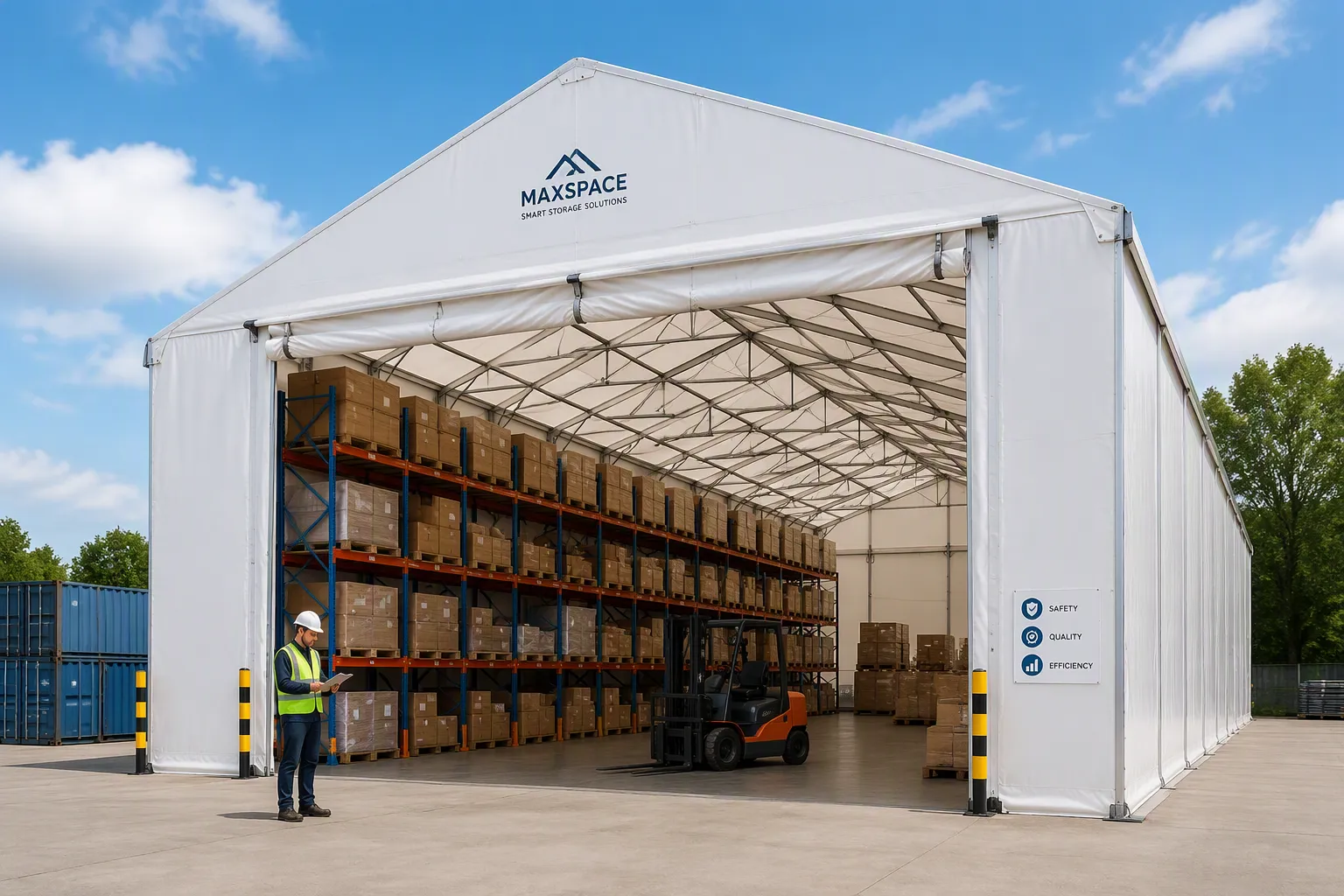
A warehouse tent is a modular, clear-span structure with an aluminum frame and a PVC fabric cover. It provides a column-free interior that maximizes usable floor space, making it ideal for storage, workshops, or equipment shelter. According to leading manufacturers like Changyi Tent, a warehouse tent is a large fabric-covered building assembled on a steel or aluminum frame. It serves as a temporary warehouse that can be erected within weeks and dismantled or relocated when no longer required. These structures range from small shelters to large clear-span buildings that hold entire production lines. The clear-span design means no interior support poles, offering 100% usable space for pallets or machinery. Eave heights can be customized to accommodate tall storage racks or vehicles. Common widths extend from 10 meters to 60 meters, with bay increments of 5 meters for easy expansion.
Common types of warehouse tents for industrial storage include clear-span tents, warehouse storage tents for inventory, inflatable storage tents for rapid deployment, vehicle storage tents for protecting fleets, and hangar tents for aviation uses. Clear-span warehouse tents are most popular because they maximize floor space without obstructions. Each type is weather-resistant and can be customized in size and configuration.
Frame and Cover Materials
At Changyi Tent, our heavy-duty frames utilize ultra-thick extruded 6061-T6 aluminum alloy (e.g., 112*203*4mm for large spans), technically anodized for complete corrosion resistance. This alloy delivers exceptional strength for spans up to 25+ meters and supports wind loads of 80–100 mph. The aluminum frame is lightweight yet strong, making it easy to transport and assemble. Hot-dip galvanized steel connectors enhance the joints for added stability, and the load-bearing capacity reaches up to 500 kg per square meter for heavy equipment storage. Wind and snow load ratings are tailored to the building's location, ensuring performance in extreme weather. Anchoring options include concrete blocks, concrete anchors, 42-inch stakes, and earth anchors, so the tent can be installed on concrete, asphalt, gravel, dirt, or grass without a heavy foundation.
The cover system utilizes industrial-grade, double-sided PVC opaque self-cleaning fabric (850g/sqm for the roof and 650g/sqm for sidewalls). This heavy-duty membrane is 100% waterproof, UV-resistant, and strictly flame retardant (complying with DIN 4102 B1 European standards). Panels are joined using high-frequency (HF) welding, which creates a molecular bond that is 100% leak-proof. This construction gives the fabric an outdoor lifespan of 10–15 years. For climate-controlled storage, insulation, HVAC, and heating can be added. Custom accessories like warehouse doors, windows, industrial lighting, and temperature-control equipment are available.
Benefits and Limitations of a Warehouse Tent
Cost, Speed, and Flexibility Benefits
A warehouse tent delivers substantial financial savings. Initial investment drops by 40 to 70 percent compared to a permanent building. A professional tent costs roughly one-third to one-fifth of a traditional concrete warehouse. No heavy foundation is needed. Permitting costs are lower. Maintenance expenses stay low. The structure is reusable and relocatable.
Deployment speed is another major advantage. Installation completes within one week. A permanent facility requires six to twelve months for design, approvals, and construction. This speed suits growing businesses, seasonal operations, and urgent storage needs. The rapid setup minimizes disruption to active work zones.
Flexibility separates warehouse tents from fixed facilities. The structure can relocate when a project ends. It can expand or downsize. It works well on leased land where permanent construction is not feasible. Industries such as logistics, construction, manufacturing, and disaster relief benefit from this adaptability. When a project ends, the tent can be dismantled and reassembled elsewhere, saving significant capital.
Key differences between the two options include:
Benefit Category | Warehouse Tent | Permanent Warehouse |
|---|---|---|
Cost | Initial investment reduced by 40–70%; no heavy foundation; reusable | High land development and construction costs; non-relocatable |
Speed | Installed within one week | Six to twelve months or longer |
Durability | Aluminum frame 15–30 years; PVC fabric 8–15 years | Extended longevity |
Flexibility | Fully relocatable; scalable for leased land | Fixed structure; costly to modify |
Durability and Insulation Limits
A warehouse tent serves as a viable semi-permanent solution. The aluminum frame lasts 15 to 30 years. The PVC membrane requires replacement every 8 to 15 years. The frame can be reused with a new membrane, extending total service life. For operations on owned land beyond 10 years, a conventional building may offer better value. For leased sites or growing businesses, the tent remains a clear winner.
Insulation presents another consideration. The PVC fabric cover does not provide thermal insulation by default. Climate-controlled storage demands added insulation panels (like sandwich walls) and HVAC equipment. These additions increase cost and add weight. Insulation can be installed during initial setup to avoid retrofitting complications. Buyers in extreme climates should factor these needs into their budget.
Warehouse Tent vs. Traditional Building
Cost and Timeline Comparison
Cost and speed separate these two options clearly. A permanent warehouse costs $50 to $100 per square foot in the United States. A temporary warehouse building costs $20 to $50 per square foot. For a 50,000-square-foot facility, the permanent option runs $2,500,000 to $5,000,000. The temporary option runs $1,000,000 to $2,500,000. Annual maintenance also favors the tent. Permanent warehouses cost $2 to $5 per square foot each year. Temporary structures cost $1 to $3 per square foot.
Timelines differ just as sharply. A traditional steel warehouse needs 3 to 6 months to build. A Changyi 40×110m aluminum warehouse tent installs in 1 to 2 weeks. This gap matters for businesses that need storage now.
Warehouse Type | Construction Timeline |
|---|---|
Traditional Steel Warehouse | 3–6 months |
Changyi 40×110m Aluminum Warehouse Tent | 1–2 weeks |
Permanence and Customization Differences
A permanent building wins on lifespan. It lasts 30 to 50 years. A temporary warehouse tent lasts 15 to 30 years (frame lifespan). Buyers who own land and plan to stay for decades may prefer concrete and steel. Buyers on leased land or facing rapid growth often choose the tent instead.
Customization favors the tent in several ways. Traditional buildings lock in their layout at construction. A tent adapts after installation. Available options include:
Insulated wall systems, HVAC integration, lighting, electrical packages, personnel doors, overhead doors, and fire safety features
Flexible wall choices such as PVC sidewalls, steel sandwich panels, ABS solid walls, glass walls, sliding doors, and rolling shutters
Foundation flexibility on concrete, asphalt, compacted soil, or existing industrial yards
Modular expansion by adding bay sections without replacing the original structure
Full relocation through disassembly, transport, and reinstallation
Key Factors When Buying a Warehouse Tent
Size, Foundation, and Climate Needs
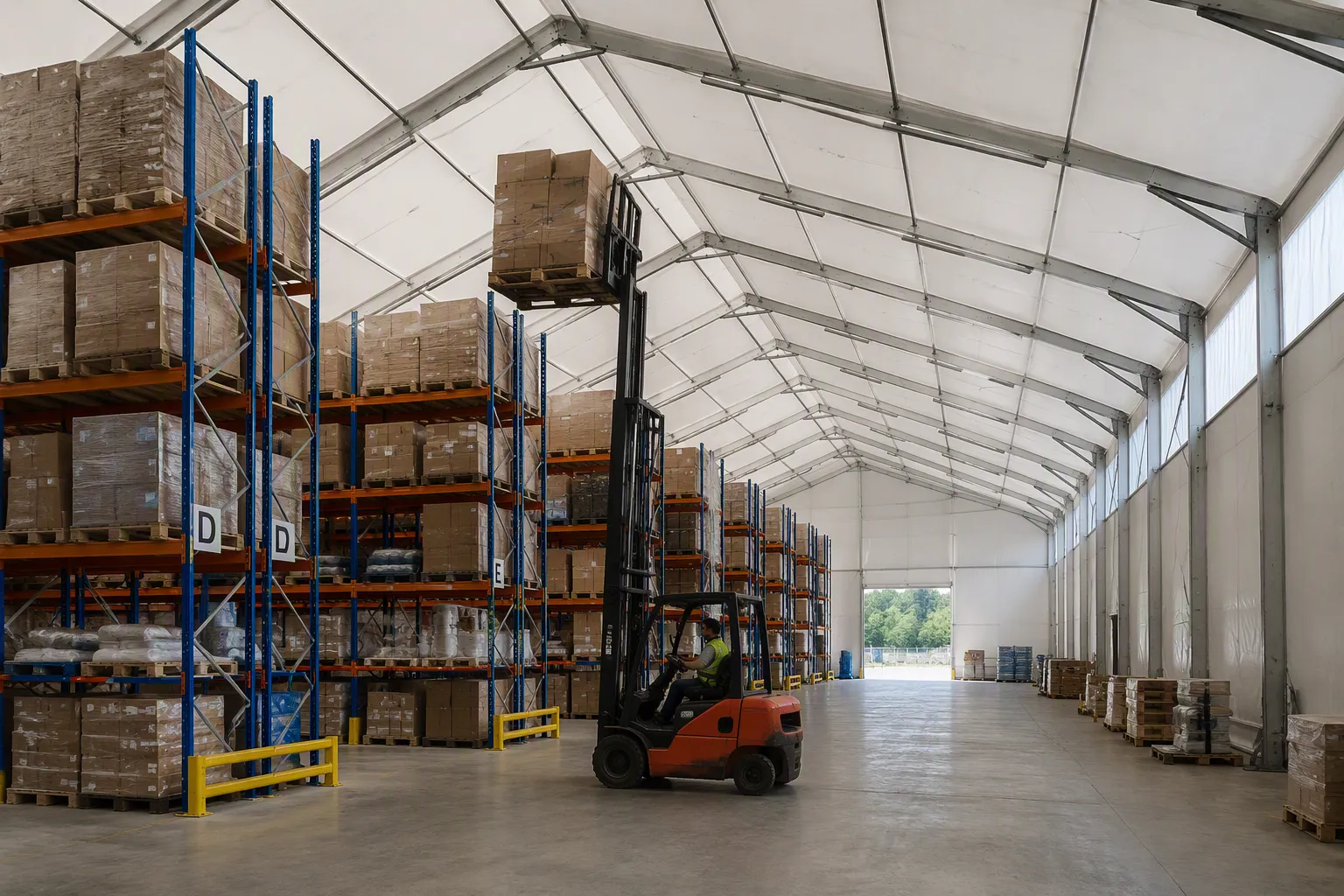
Size drives every other decision. Buyers should measure their pallet footprint first. Then they match that footprint to a clear-span width. A column-free interior allows unobstructed pallet racking and efficient forklift circulation. Clear spans reach up to 60 meters. Modular expandability comes in 5-meter increments. This design supports changing demand, seasonal inventory, or production-adjacent storage.
Eave height determines how many racking tiers fit across the floor plan. Standard industrial racks often reach 12 to 16 feet. A structure with only a 10-foot eave height loses the outer rows of vertical storage. Side walls should clear the top rack tier by at least three feet. This gap gives forklift operators visual clearance to lift and place top-tier loads safely.
Span Width | Eave Height | Best Application |
|---|---|---|
10 m | 4.0 m | Small parts storage, tool shed |
15 m | 4.0 m | Mid-size fulfillment, returns processing |
20 m | 4.0–5.0 m | Pallet racking warehouse |
25–30 m | 4.0–5.0 m | Full distribution center |
40–60 m | 5.0 m | Heavy industrial, manufacturing overflow |
Foundation choice depends on the site. Warehouse tents install on concrete, asphalt, compacted soil, or existing industrial yards. Anchoring options include concrete blocks, concrete anchors, 42-inch stakes, and earth anchors. Climate needs shape material selection. Corrosion-resistant frames and UV/water-resistant fabric handle extreme weather. Temperature control for perishable goods requires insulation and HVAC integration.
Regulations, Supplier, and Warranty
Local building codes may classify a warehouse tent as a temporary structure. Some jurisdictions require permits for tents above a certain size. Buyers should verify local regulations before purchase. A supplier experienced in permit applications can streamline the process.
Supplier credentials matter. Look for ISO 9001:2015 certification, which verifies an integrated Quality Management System. CE marking is mandatory for products sold in the European Economic Area. At Changyi Tent, all products are backed by TUV and SGS certifications, and independent material tests verify fabric properties like fire resistance and tensile strength. A reliable factory also offers OEM and ODM services, technical guidance for installation, and 100% product testing before delivery.
Warranty terms deserve careful review. Frame warranties often run 10+ years from delivery date and cover structural defects under normal use. Fabric warranties typically run 1 to 2 years and cover manufacturing defects. Neither covers misuse, improper assembly, or normal wear and tear.
Buyers should ask for references or case studies. Past projects in logistics, manufacturing, and relief efforts demonstrate real-world performance.
Choosing the Right Warehouse Tent for Your Needs
Assessing Storage Needs and Budget
Start with a clear picture of what you will store. Calculate the total volume of goods and the space they occupy. Match that figure against your available land area. Factor in access points for inventory management, ventilation, and circulation. These elements affect how much usable space you actually have.
Next, consider the racking system. Review the kinds of items, their weight, and how often they will be accessed. This determines the right racking choice:
Selective racking works best for varied products with frequent access.
Drive-in or drive-through racking suits high-density storage of similar items.
Cantilever racking handles long items like pipes or lumber.
Multi-tiered racking optimizes vertical space to increase capacity.
Budget estimates for 2025-2026 give a helpful starting point:
Tent Size | Area (sqm) | Price Range ($/sqm) | Total Cost Estimate ($) |
|---|---|---|---|
Small | 100–300 | 30–60 | 3,000–18,000 |
Medium | 500–1,000 | 25–50 | 12,500–50,000 |
Large | 2,000+ | 20–40 | 40,000–80,000+ |
Comparing Supplier Quotes and Warranties
When you get quotes from different suppliers, ask the right questions. The details matter:
What site preparation is included (grading, base, slab, drainage)?
What anchoring method is included, and who handles approvals?
What doors, walls, and accessories are included, and what are their specifications?
What documentation comes with the quote (stamps, calculations, certificates)?
As an integrated factory, Changyi Tent offers direct OEM and ODM services without middleman markups. Our technical guidance team assists with installation online or on-site. All products undergo 100% testing before delivery. Spare parts are available through integrated inventory systems, and response time for urgent requests stays under one hour.
A warehouse tent delivers fast, flexible, and cost-effective storage. It also carries trade-offs in permanence and regulation. Buyers should match the structure to their operational needs. Size, climate, and pallet layout all shape the final choice.
Start by outlining your storage requirements. Then contact reputable manufacturers for quotes. A carefully chosen tent can be a smart investment. It works well for temporary or expanding storage needs. The right structure protects goods and supports growth.
Ready to Expand Your Storage Capacity?
Don't let supply chain bottlenecks or construction delays slow your business down. Contact Changyi Tent’s engineering team today for a free site assessment, custom 3D design, and a competitive factory-direct quote.
Get Your Free Quote NowFAQ
How long does a warehouse tent last?
The aluminum frame lasts 15 to 30 years. The PVC fabric cover needs replacement every 8 to 15 years. The frame can be reused with a new membrane. This extends total service life well beyond the first cover.
How fast can a warehouse tent be installed?
Installation completes within one week. Small units under 500 square meters can be ready in one day. Large sites over 1000 square meters usually need 3 to 5 days. A permanent building takes six to twelve months.
Does a warehouse tent need a foundation?
No heavy foundation is required. The structure installs on concrete, asphalt, compacted soil, or existing industrial yards. Anchoring options include concrete blocks, concrete anchors, 42-inch stakes, and earth anchors. This flexibility lowers site preparation costs.
Can a warehouse tent be climate controlled?
Yes. Insulation panels (like sandwich walls) and HVAC equipment can be added. These additions increase cost and add weight. Buyers in extreme climates should install insulation during initial setup to avoid retrofitting complications later.
What should I look for in a warehouse tent supplier?
Look for ISO 9001:2015 certification, CE marking, and TUV/SGS testing reports. Ask about OEM and ODM services, technical guidance for installation, and 100% product testing before delivery. Request references from past projects.