

How to Choose the Right Sports Tent for Your Team
Choosing a sports tent for a club, school, or tournament is a capital investment decision, not a retail purchase. The right modular sports tent turns an unused plot of land into a weatherproof, column-free indoor court in a matter of weeks — at 40–70% less cost than traditional construction. This guide walks facility owners, athletic directors, and event organizers through the four decisions that actually matter: clear-span sizing, frame structure, fabric durability, and customization. By the end, you will know exactly which specification to request from your supplier.
Key Takeaways
Size a sports tent by clear span and eave height, not by floor area alone — every sport has minimum run-off and height requirements.
Modular aluminum structures go up in days to weeks and typically cost 40–70% less than steel or concrete buildings.
Specify anodized 6061/T6 aluminum frames and double PVC-coated polyester covers for a 15–20 year service life.
Verify wind and snow load ratings (80–120 km/h wind; 50–75 kg/m² snow) against your local climate before ordering.
Customize walls, climate control, flooring, lighting, and branding to turn a simple shelter into a year-round, revenue-generating venue.
Choosing the Right Sports Tent Size: Start with Clear Span
Match Clear Span and Eave Height to Your Sport
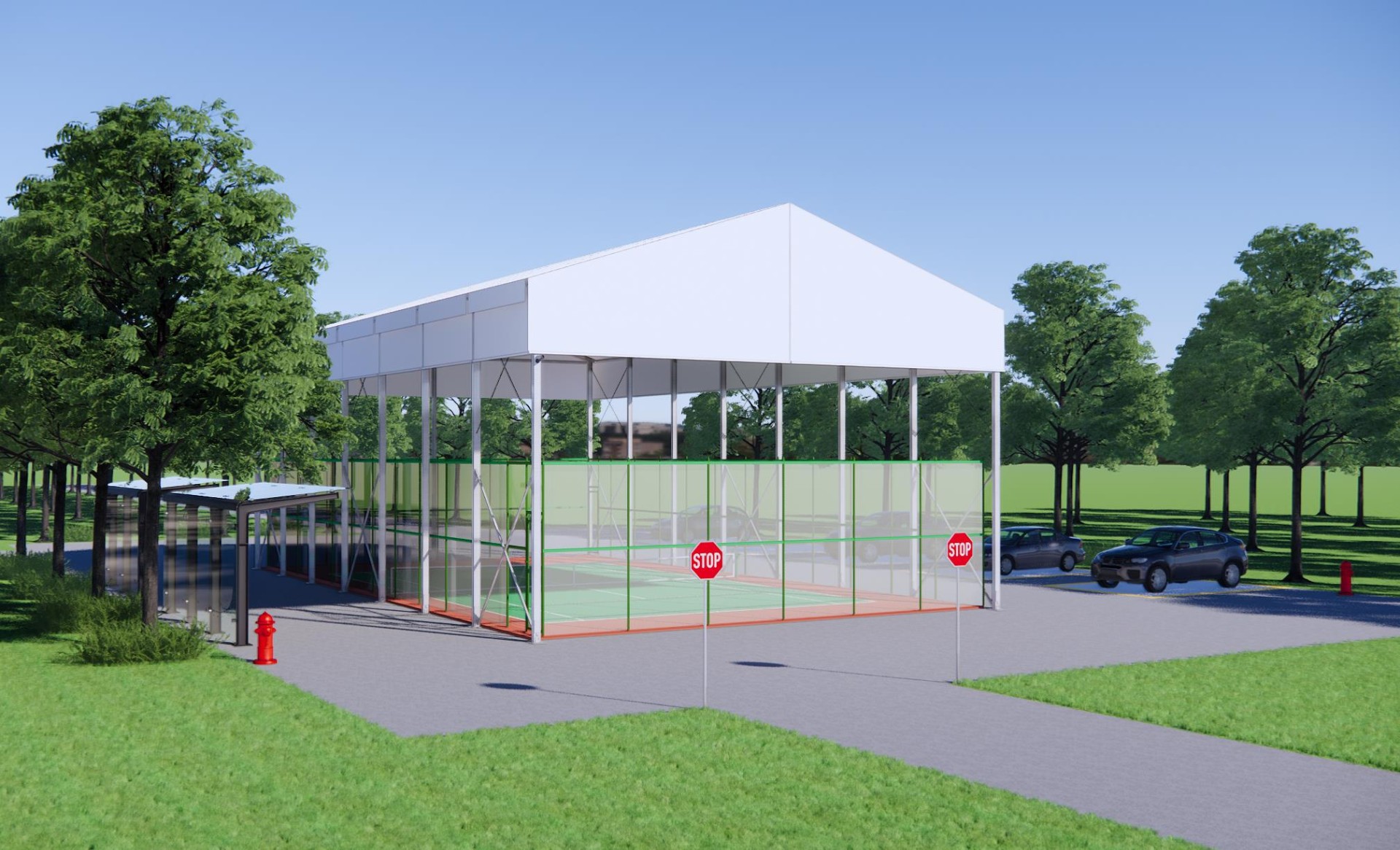
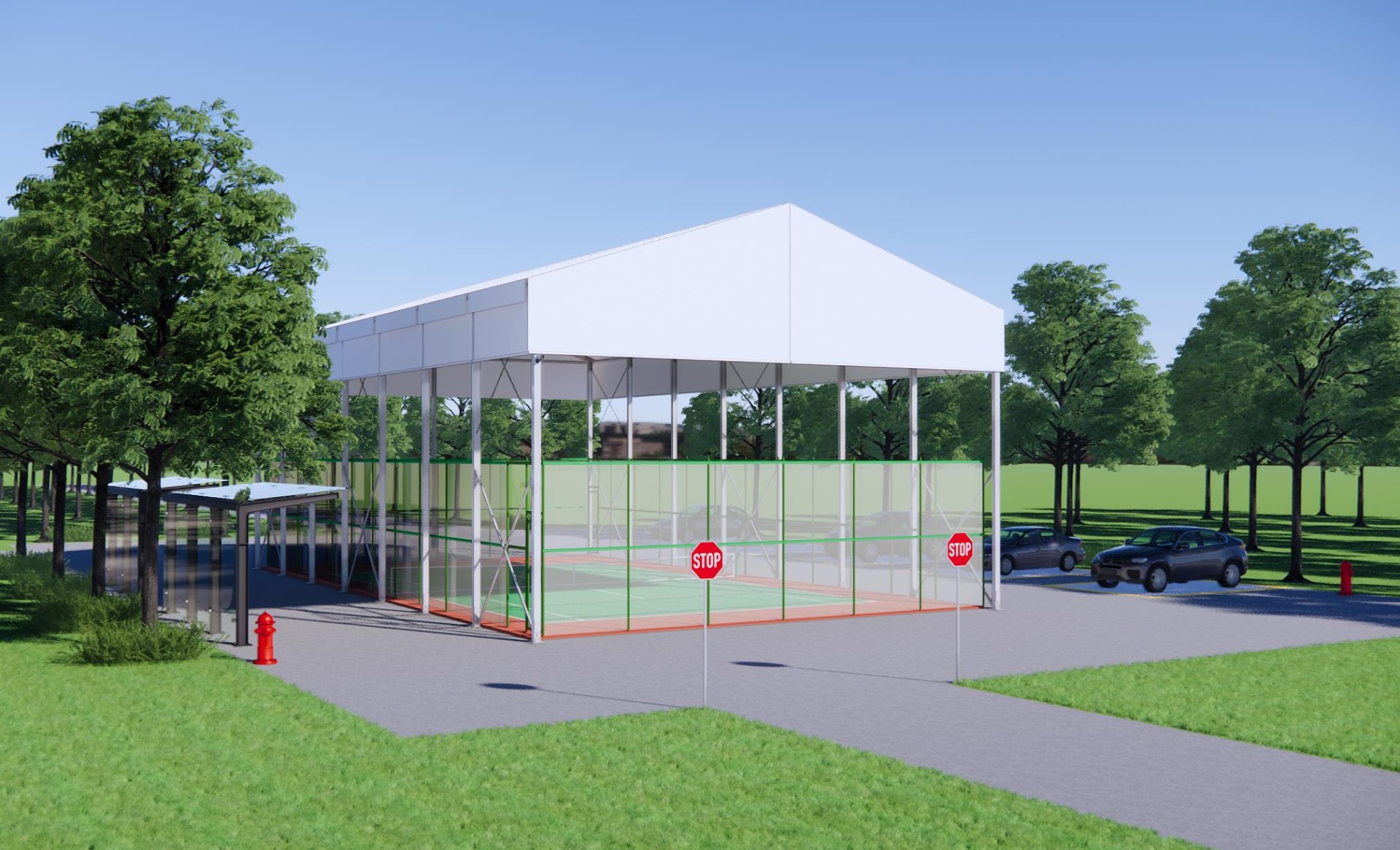
Clear span — the unobstructed width between sidewalls — is the single most important number on a sports tent specification sheet. Because modular structures carry the roof load on the frame alone, there are no interior columns, and every square meter of the footprint stays playable. Eave height (sidewall height) and ridge height then determine whether lobs, smashes, and high balls stay in play.
Always add run-off margins around the court: roughly 3–5 m behind baselines for club-level tennis, about 2 m around each badminton court, plus space for benches, scoring tables, and spectator rows. The table below summarizes proven configurations from Changyi's installed sports projects.
Sport Application | Recommended Clear Span | Recommended Length | Recommended Eave Height |
|---|---|---|---|
Badminton (4–6 courts) | 17–25 m | 33–45 m | 6–9 m |
Tennis (single court) | 18–22 m | 30–36 m | 7–10 m |
Padel (1–2 courts) | 11–23 m | 21–43 m | 6–8 m |
Pickleball (4–8 courts) | 20–40 m | 30–60 m | 6–8 m |
Basketball / futsal (training) | 30–50 m | 40–80 m | 8–12 m |
Changyi manufactures clear spans from 3 m up to 50 m, with length extendable in 3 m or 5 m bays, so the same structural family can cover anything from a single training court to a multi-court complex. When in doubt, order one bay longer than your minimum: extending a finished building always costs more than planning the extra length now.
Plan for Spectators, Storage, and Services
A frequent planning mistake is sizing the tent to the court only. Tournament operators should reserve 15–20% of the footprint for circulation, spectator seating, equipment storage, and a mechanical room. Entrance modules, pagoda annexes, or a glass-walled lobby can house registration and hospitality without enlarging the main span.
Modular Sports Tent vs. Traditional Construction
Speed, Cost, and Permitting
For most clubs and schools, the business case for a sports tent is decided before materials are even compared. Traditional gymnasiums demand deep foundations, full building-code permits, and 12–24 months of construction. A modular sports tent is engineered, manufactured, and assembled on site in weeks, and in many regions is classified as a temporary or semi-permanent structure, which simplifies approval. If you are new to modular structures, our explainer on the difference between a tent and a marquee is a useful starting point.
Factor | Modular Sports Tent | Traditional Steel/Concrete Building |
|---|---|---|
On-site construction time | 2–6 weeks | 12–24 months |
Capital cost | 40–70% lower | Baseline |
Foundation | Anchors or weight plates on existing ground | Deep concrete foundation |
Permitting | Often classed as temporary structure | Full building-code process |
Relocation | Dismantle and rebuild elsewhere | Fixed asset |
Expansion | Add bays modularly | Major renovation |
Aluminum Alloy vs. Steel Frames
The frame is the skeleton of the building. Anodized 6061/T6 aluminum alloy offers the best strength-to-weight ratio for spans up to roughly 50 m: it is rust-proof, light enough for fast installation, and stable across temperature swings. Heavy-duty steel components are reserved for connection points, foot plates, and ultra-large or high-snow-load projects.
Changyi sports tent frames are engineered from anodized 6061/T6 aluminum alloy with zinc-coated steel foot plates and reinforced corner connectors — a combination that delivers a 15–20 year frame service life while keeping the structure light enough to relocate.
The company's Y7 series, for example, pairs anodized aluminum profiles with zinc-coated steel foot pads for added stability on uneven ground. If you are comparing suppliers, ask for the alloy grade, wall thickness, and anodizing certificate — these three numbers separate a building-grade modular sports tent from a decorative canopy.
Durability Essentials: Fabric, Wind, and Snow Loads
Double PVC-Coated Polyester Covers
The cover is what players see and touch every day. Changyi sports tents use double PVC-coated polyester fabric (typically 650–900 g/m²) that is fully waterproof, UV-stable, and flame retardant to DIN 4102 B1 / M2 standards. A self-cleaning lacquer finish keeps the roof bright under years of sun and rain, and a double-layer roof option adds thermal insulation and acoustic damping for indoor courts.
Expect 5–8 years of service from the fabric under normal UV exposure, with straightforward panel-by-panel replacement when the time comes — without touching the frame.
Engineered Wind and Snow Resistance
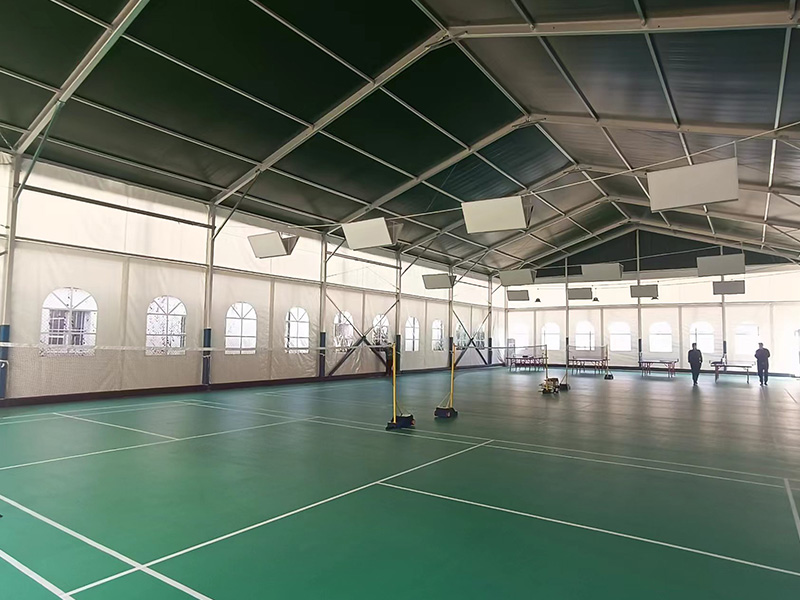
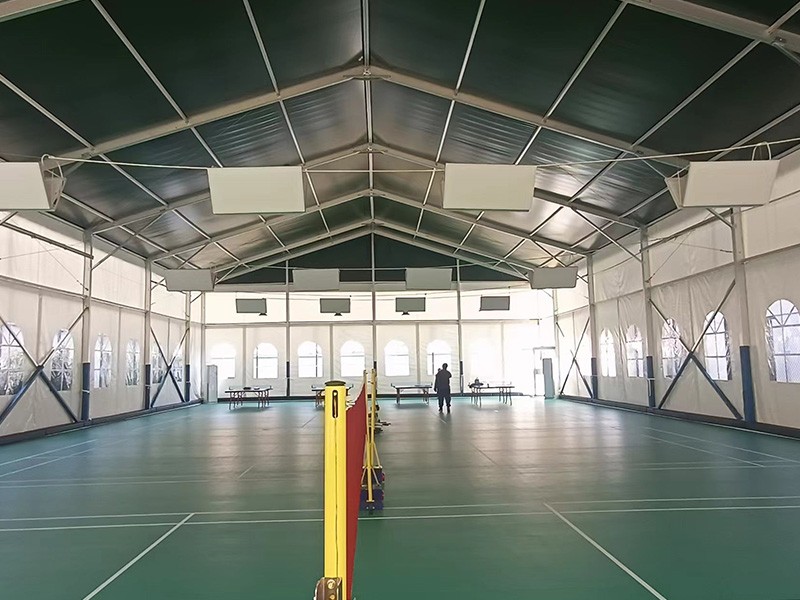
Standard Changyi sports tent designs carry wind loads of 80 km/h; reinforced frames and bracing raise the rating to 100–120 km/h, with snow loads up to 50–75 kg/m² depending on configuration. The installed badminton court tents in Anhui province, for instance, are rated for wind loads up to 100 km/h — a figure achieved through reinforced frames, correctly tensioned fabric, and the right anchoring scheme for the site.
Anchoring follows the ground condition: expansion bolts on concrete, steel ground anchors on grass and compacted soil, and weighted ballast plates where drilling is not permitted, such as rooftop courts or paved school yards. Always request the anchoring plan together with the quotation, not after installation.
Customizing Your Sports Facility: Walls, Climate, and Branding
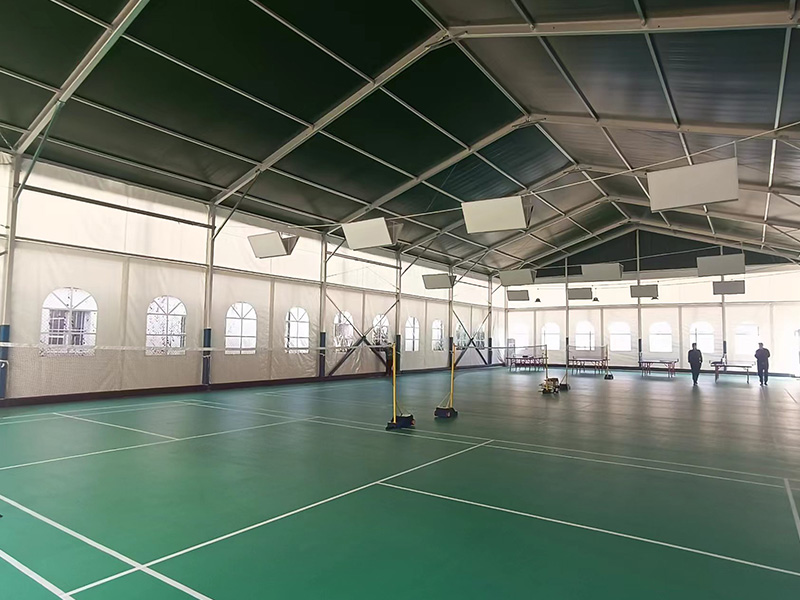
Wall Systems: Glass, Sandwich Panels, PVC, and ABS
Sidewalls decide how the venue performs across seasons. Changyi manufactures every wall type in-house, so the envelope can be matched to climate, budget, and architecture.
Wall System | Best For | Key Benefits |
|---|---|---|
Glass walls | Premium clubs, daylight-heavy venues | Maximum natural light, upscale appearance, full visibility |
Insulated sandwich panels | Year-round facilities with HVAC | Thermal insulation, energy savings, clean interior finish |
PVC sidewalls (with windows) | Cost-effective seasonal venues | Lightweight, printable with logos, easy to replace |
ABS hard walls | High-impact zones, equipment sides | Rigid, impact-resistant, secure |
Climate Control, Flooring, and Lighting Integration
A year-round venue is an envelope plus a climate plan. Insulated sandwich-panel walls and a double-layer roof allow standard HVAC units to hold 16–22 °C indoors in both summer and winter; ventilation louvers and exhaust fans manage humidity during peak occupancy. Inside, specify sport-appropriate surfaces — PVC sports flooring for badminton and volleyball, acrylic or synthetic surfaces for tennis and pickleball — and anti-glare LED lighting at 300 lux for training or 500–750 lux for competition. Deciding these systems during the structural design phase avoids costly retrofits.
Team Branding and Sponsor Visibility
Branding turns a shelter into a landmark. PVC sidewalls and roof gables can be printed single- or double-sided with team colors, logos, and sponsor graphics — an important revenue line for clubs that sell perimeter branding. Combined with a colored frame finish and a glass-walled entrance, the facility reads as a professional venue from the parking lot.
Buy or rent? Operators with a year-round program should own: purchase pays for itself across seasons and unlocks full customization, while rental suits one-off tournaments and seasonal overflow.
Final Checklist Before You Order
Confirm clear span, length, and eave height against your sport's federation run-off rules.
Verify frame alloy (6061/T6), wall thickness, and wind/snow load certificates.
Choose the wall system that matches your climate and HVAC plan.
Specify flooring, lighting lux levels, and ventilation during the design phase.
Request a site-specific anchoring plan for your ground condition.
Supply logo and color files before fabrication so branding is printed, not applied later.
Changyi's engineering team can turn a court layout and a site photo into a complete specification — span, height, walls, anchoring, and accessories — within one working day. Send your requirements to get a free quote and drawing before your next season starts.
FAQ
How long does it take to build a modular sports tent?
Unlike traditional gymnasiums that take 12–24 months, a modular sports tent is manufactured in the factory and assembled on site in days to weeks. A standard single-court facility typically takes 3–7 days of on-site installation with a trained crew.
Do sports tents require a concrete foundation?
No. Sports tents use adaptable anchoring systems: expansion bolts on concrete, steel ground anchors on grass or compacted soil, and weight plates where drilling is not allowed. This makes them ideal for leased land, school fields, and rooftop sites.
What is the lifespan of an aluminum sports tent?
The anodized aluminum alloy frame lasts 15–20 years or more with basic maintenance. Double PVC-coated covers typically serve 5–8 years depending on UV exposure, and individual fabric panels can be replaced without dismantling the frame.
Can a sports tent handle extreme weather?
Yes. Standard designs resist 80 km/h winds; reinforced configurations reach 100–120 km/h with snow loads up to 50–75 kg/m². For hot or cold climates, add insulated sandwich panels and HVAC to keep the interior comfortable year-round.
Can one sports tent host multiple sports?
Yes. A clear-span hall can be divided with netting or curtain systems — for example, badminton and pickleball courts side by side — and re-opened for tournaments, exhibitions, or exams. Multi-use scheduling is one of the strongest revenue arguments for modular sports halls.