

Why a Badminton Tent May Beat a Traditional Indoor Court
Badminton lovers know the struggle. Finding an open indoor badminton court feels impossible. You check the schedule, and every prime slot is gone. When you do book, the price stings. In urban centers, indoor badminton courts often charge premium rates per 45–60 minute slot, and those costs add up fast for club owners and players alike.
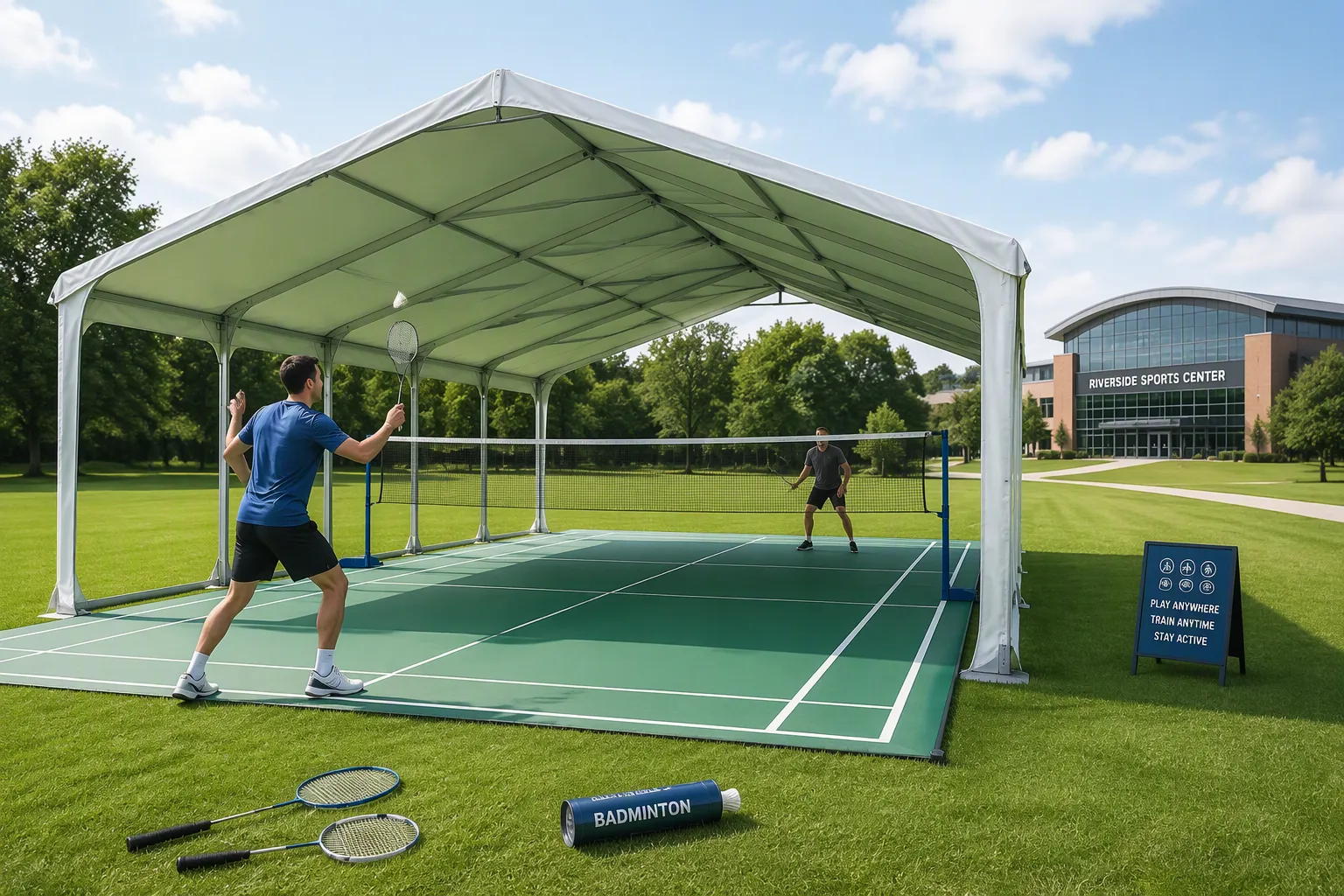
A badminton tent changes the equation. For many facility operators and players, this structure beats a traditional facility on cost, flexibility, and installation speed. You get more space, reliable quality, and room to grow. Playing badminton here feels just as professional as any permanent gym. A tent delivers all of this without the headaches of permanent construction.
Key Takeaways
A badminton tent costs far less than a traditional indoor court.
A badminton tent installs in days. Clubs can open fast and earn revenue sooner.
A badminton tent can meet professional play standards. Proper apex height and lighting make this possible.
A badminton tent fits almost any flat site. It easily expands from 2 to 7 courts.
A badminton tent supports casual games, serious training, and local tournaments.
Building an Indoor Badminton Court: Cost and Timelines
Budget and timeline dictate the success of most sports facility projects. A badminton tent optimizes both variables in your favor. The total investment for a tent-based court ranges from $25,000 to $250,000. That range covers everything from a single standard court at $25,000–$45,000 to a commercial hall with 3–8 courts, lighting, flooring, and basic facilities at $70,000–$250,000. A four-court combination lands at $80,000–$130,000, while a 3–6 court facility costs $120,000–$220,000.
Lower Cost with a Badminton Tent Setup
CHANGYI TENT offers factory-direct pricing at $15–$50 per square meter. A standard court area costs just $2,452–$4,087 for the tent structure itself. Simple tents run $1,000–$3,000, while professional, fully-equipped tents reach $2,450–$4,100. These figures make membrane structures highly attractive for budget-conscious commercial projects.
Setup happens in days, not months. Pre-engineered components arrive ready to assemble. For instance, a recent CHANGYI TENT commercial badminton hall project (such as our Anhui Badminton Tent case) was fully operational in less than half the time required for traditional steel structure buildings. The overall construction period dropped by more than 50 percent compared with permanent construction. This speed enables rapid delivery and immediate revenue generation.
Faster build compared to traditional sports buildings. The structure can be installed in a much shorter timeline.
Hidden Expenses of Permanent Indoor Courts
Traditional concrete or steel structures carry expenses that rarely appear in the initial quote. Building an indoor badminton court with permanent construction means paying for HVAC systems, specialized flooring, locker rooms, restrooms, spectator seating, electrical installation, doors, and professional services like permitting and architectural fees.
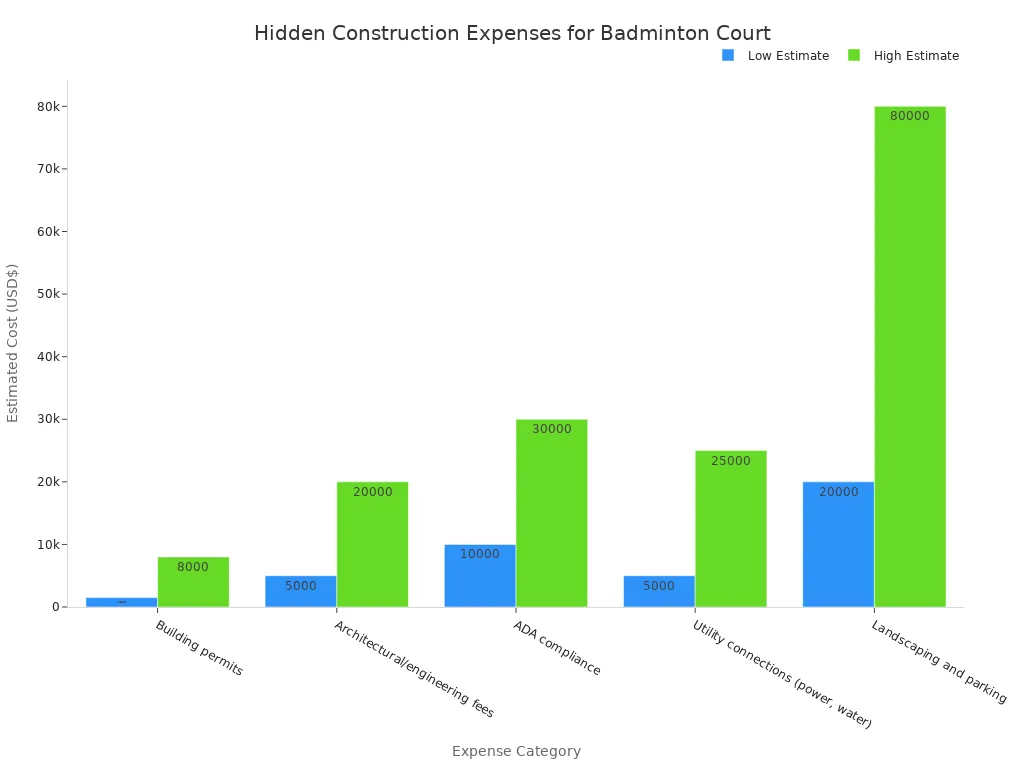
The list of hidden expenses quickly escalates. Building permits can cost $1,500–$8,000. Architectural and engineering fees run $5,000–$20,000. ADA compliance adds $10,000–$30,000. Utility connections for power and water reach $5,000–$25,000. Landscaping and parking push $20,000–$80,000.
A tent eliminates most of these fees. No structural engineering for load-bearing walls is needed. No ductwork for central HVAC. No permanent utility trenches. The cost stays predictable from day one.
Traditional structures also demand longer permitting timelines. Municipal reviews, zoning approvals, and inspections add weeks or months. A tent often qualifies as a temporary or semi-permanent structure, which bypasses many of these steps. For anyone building an indoor badminton court on a tight schedule, this difference matters enormously.
The financial case is clear. A badminton tent delivers a playable indoor badminton court for a fraction of the cost and time. That advantage lets clubs, schools, and small operators open their doors faster and start earning revenue sooner.
Can a Sports Tent Match an Indoor Badminton Court?
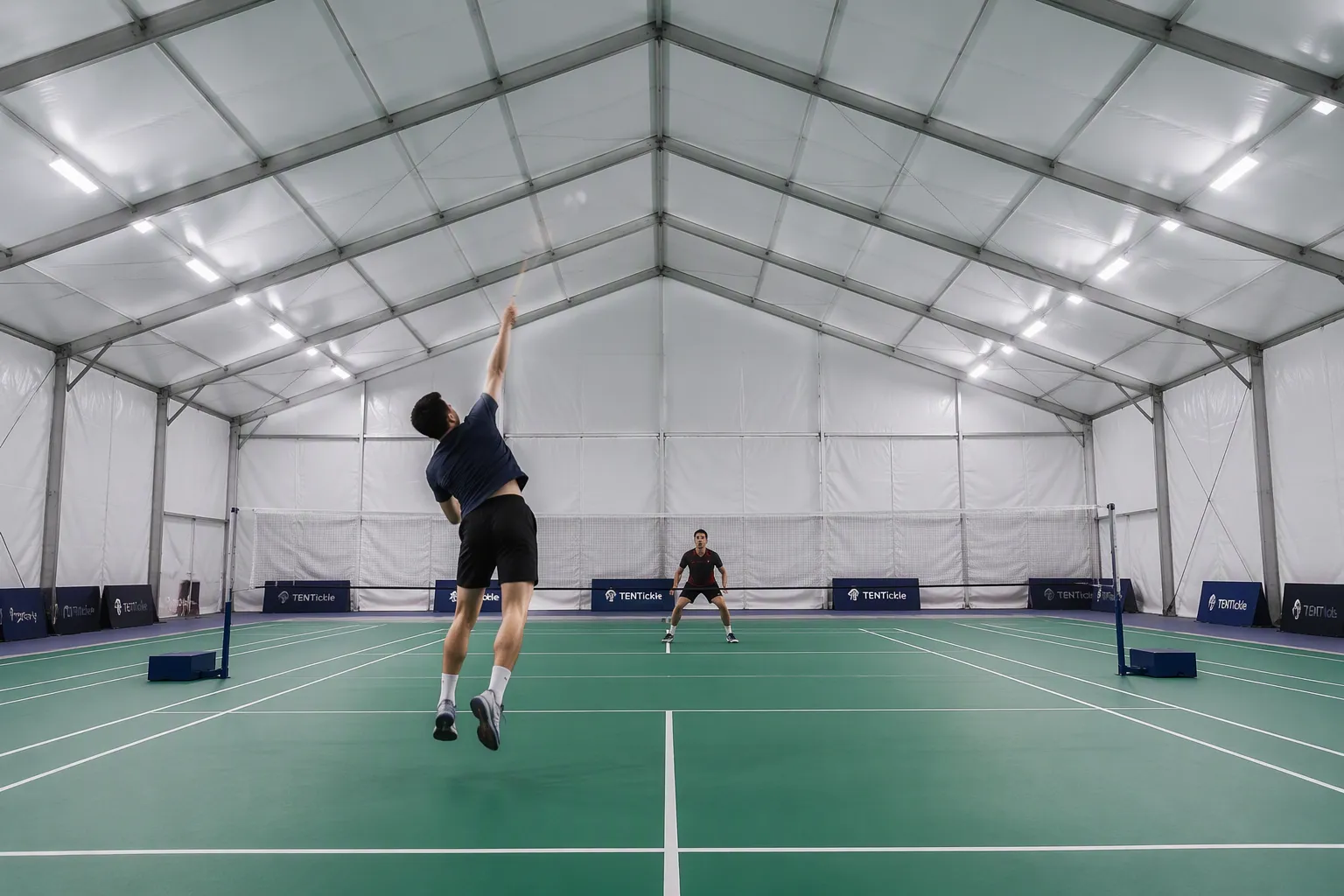
A common hesitation is quality. Players wonder if a fabric structure can replicate the feel of a permanent gym. The answer is yes. With the right engineering and upgrades, a sports tent delivers an indoor experience that meets professional standards. The key factors are height, lighting, and environmental control. Modern large-span tent structures solve each requirement effectively.
Clear-Span Design and Height Requirements for Badminton
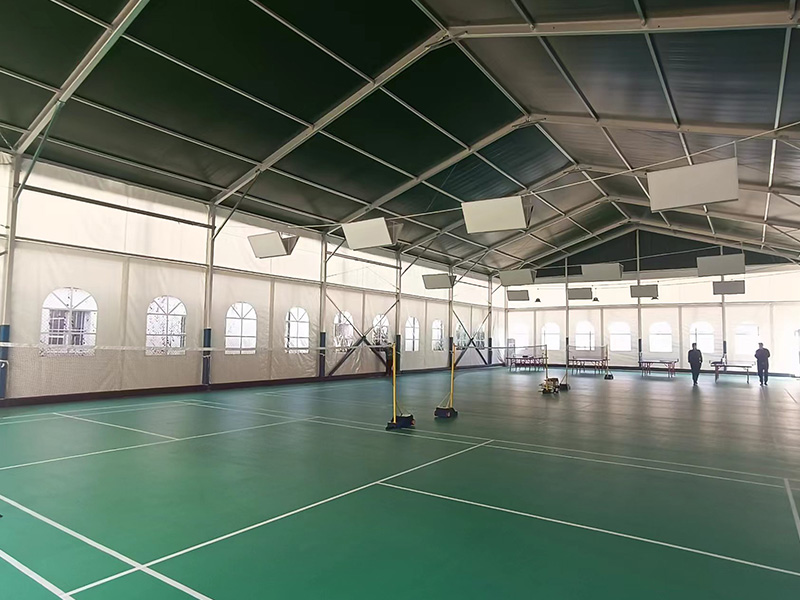
Height matters immensely in badminton. A shuttlecock hit high during a smash or lob needs unobstructed vertical space. The large-span tents from CHANGYI TENT (available in profiles like A-frame or Arcum roofs) use a clear-span design with no internal support poles. This eliminates any risk of collisions with columns. While the eave (side) heights range from 6m to 8m (20–26 ft), the apex height (peak clearance) easily exceeds 9.5 meters, comfortably satisfying the strict clearance standards for competitive play.
The table below shows the official height requirements for a badminton court:
Requirement | Height (Imperial) | Height (Metric) |
|---|---|---|
Overall clearance height | 30 feet | 9.1 meters |
Free space above net | 17 feet | 5.18 meters |
A standard indoor badminton court needs that full vertical clearance. The large-span tent achieves this with its high-peak design. Players can execute full smashes and defensive clears without hitting the ceiling. The badminton court size and clearance both fit comfortably within the tent's span width (e.g., 15m, 18m, or wider). This makes the structure highly viable for serious training and local competitions.
Controlled Environment: Lighting, Ventilation, and Weather Resistance
Lighting quality directly affects gameplay. A dark or unevenly lit court hampers visibility and reaction time. The badminton tent accepts professional LED sports lighting as an integrated upgrade. These systems deliver 800–1,000 lux average illuminance with uniformity above 0.7. For context, the Badminton World Federation (BWF) recommends 500–750 lux for standard play.
Different classes of competition require different lux levels:
Class | Lux Level |
|---|---|
Class 1 | 750 lux |
Class 2 | 500 lux |
Class 3 | 300 lux |
The tent easily meets Class 1 standards with the right lighting package. This means it fully supports tournament-level visibility.
Ventilation is another concern inside a tent. Stagnant air makes playing badminton uncomfortable. CHANGYI TENT offers HVAC integration and advanced ventilation systems for the structure. These maintain airflow and temperature control comparable to traditional concrete or steel structures.
Weather resistance is built into the core materials. The PVC fabric carries DIN 4102 B1 flame retardancy certification. It resists wind loads up to 100 km/h (or higher with custom reinforcement) and is 100% waterproof. The cost of these upgrades remains predictable because they come from a single, reliable supplier. No coordination with multiple contractors is needed.
Membrane structures like this prove that a fabric enclosure can rival a permanent indoor badminton court. The playing surface, lighting, and climate control all meet rigorous standards. Players get professional conditions without the permanent construction burden.
Site Flexibility and Scalability for a Badminton Tent
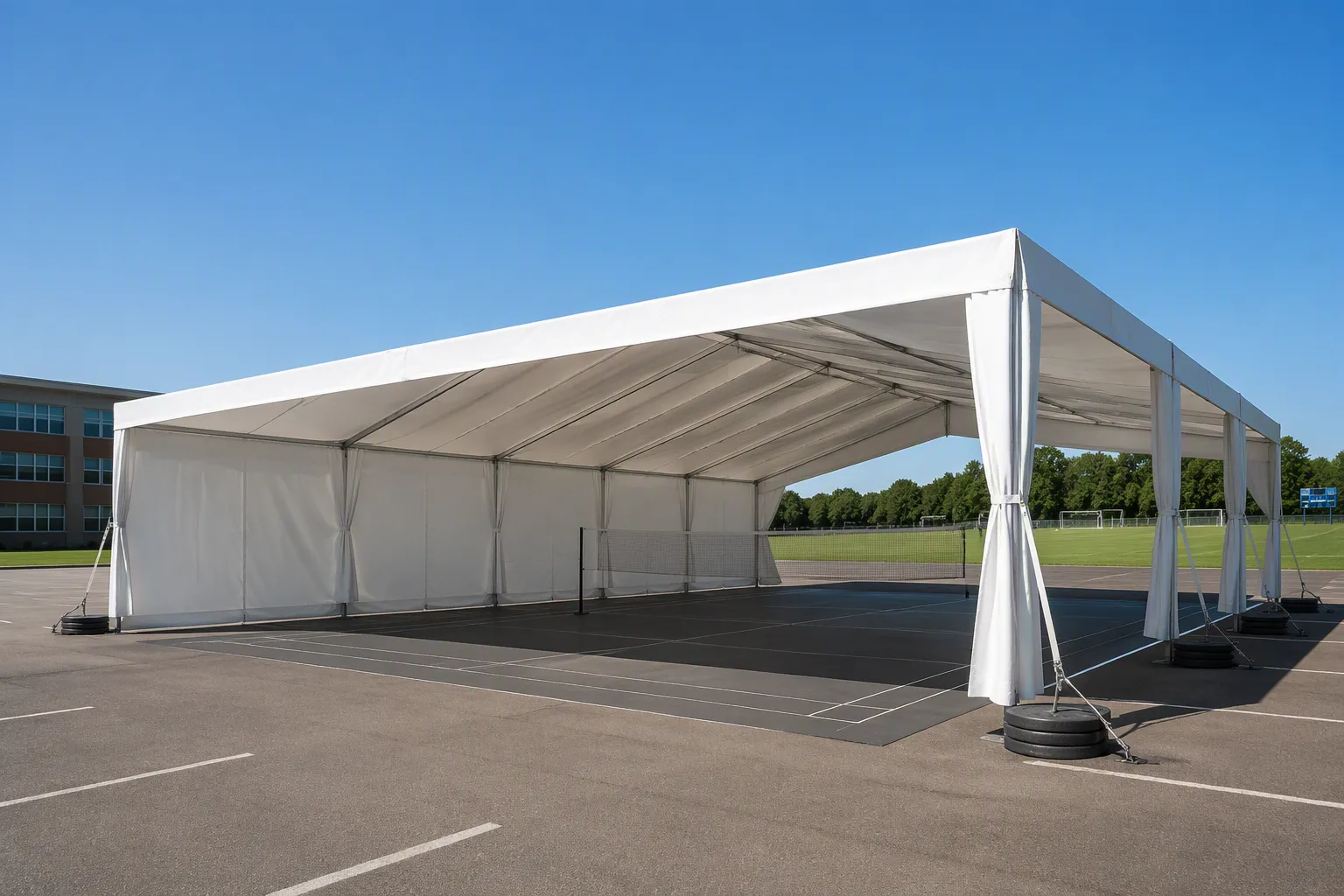
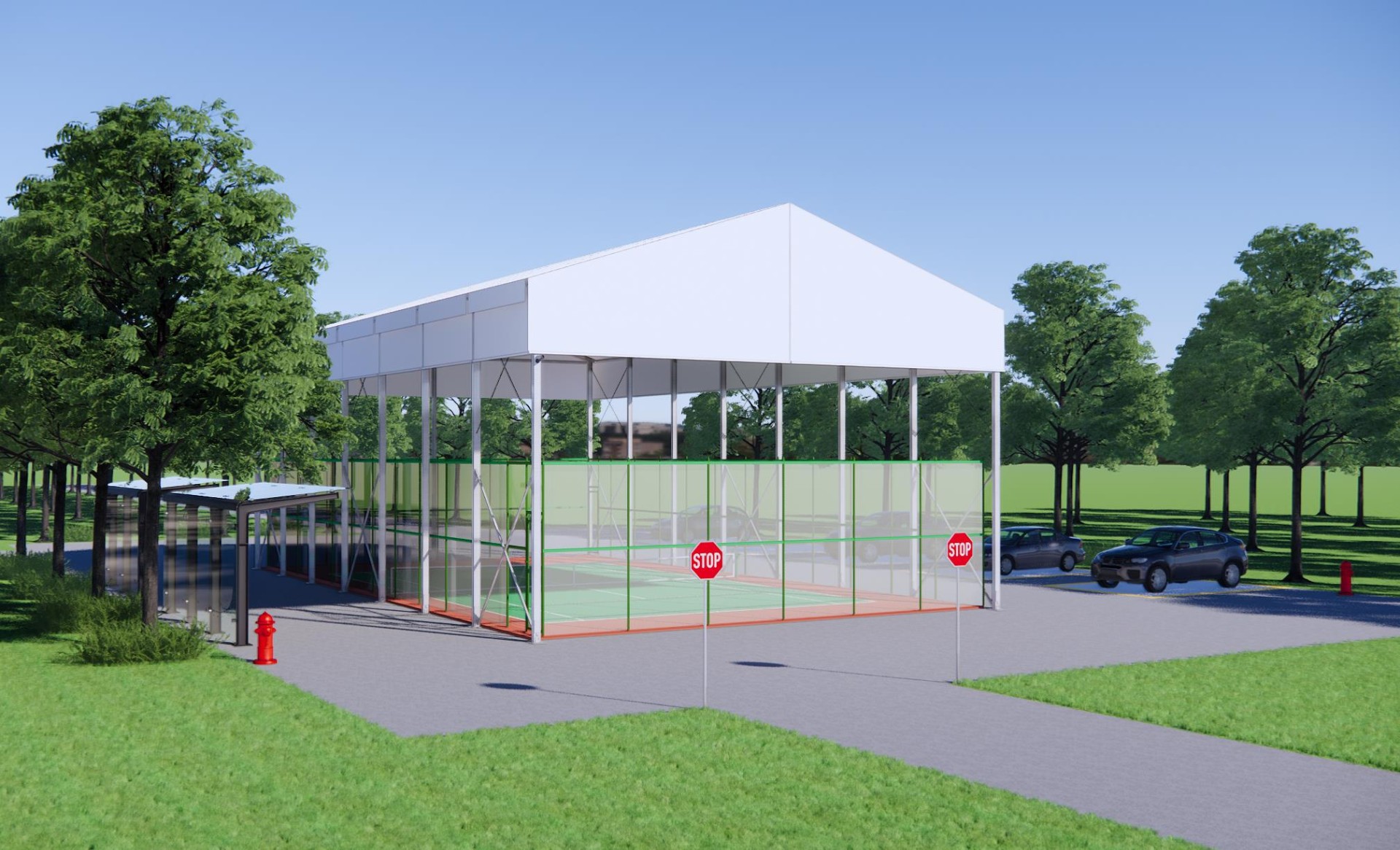
Site selection often halts facility projects. Finding a suitable location for a permanent building is difficult and expensive. A badminton tent removes this limitation. It sits on almost any flat surface. Schools, clubs, and sports facility operators can transform existing spaces into functional courts without preparing a deep foundation.
Any Flat Space Becomes an Indoor Court
A tent requires minimal site preparation. No concrete foundations are needed. No extensive construction permits are required in most locations. The structure uses ground anchors, expansion bolts, or weight plates for stabilization. This setup works on grass, sand, asphalt, cement, or marble surfaces. Concrete and asphalt serve as ideal bases. Temporary sports flooring layers also work well. The surface must be smooth and level. Debris removal and ground-leveling prevent water pooling. A tarp or ground sheet adds protection if needed.
This surface tolerance makes the tent ideal for parking lots, school fields, and even rooftops. Traditional permanent court construction cannot match this flexibility. Sports tents allow quick deployment and removal. They are modular and easy to transport. A facility can move the same structure across different locations for seasonal or event-based use. Membrane structures offer a significant advantage over permanent buildings. The large-span tent design eliminates internal poles, creating uninterrupted space for play. A permanent court normally requires a dedicated building. A tent delivers the same experience without that constraint. A school with an unused asphalt lot can install a tent in days. A club hosting a weekend tournament deploys the structure on a grassy field. The same tent moves to a new site next season. No construction waste remains behind.
Modular Expansion from 2 to 7 Courts
The tent grows with the user. It uses a modular bay system with 3m or 5m spacing. This design allows for seamless expansion. A single-court indoor badminton setup can expand to accommodate 2, 4, or up to 7 courts inline. The span width easily fits standard indoor badminton court layouts side-by-side with safety buffer zones. Each bay adds length without altering the primary structure.
A clear span of more than 30 meters can accommodate multiple side-by-side courts without internal columns. This design eliminates support poles that would interfere with gameplay. The modular approach means users buy only what they need initially. They add bays later as demand grows. This adaptability gives prefabricated structures a clear advantage over fixed facilities. The cost remains predictable at each stage. Sports arena tents offer this scalability without the complexity of permanent construction. Modular aluminum structures provide the framework for this flexibility. Playing badminton in a tent feels no different from a gym, but the site options far exceed it. A club starts with two courts and expands to six over two years. Each expansion requires only additional frame bays and cover sections.
Professional Experience in a Badminton Tent
Turnkey Solutions for Serious Training
CHANGYI TENT closes the gap between fabric structures and permanent courts through full turnkey integration. The company supplies lighting, professional badminton flooring, HVAC, and ventilation as a single package. This removes the need to coordinate multiple contractors. Custom engineering addresses local climate loads. Buyers in high-wind or heavy-snow regions receive tailored structural designs.
Several reinforcement options exist for demanding sites:
Wind and snow load compliance with local building codes
Seismic reinforcements for earthquake-prone locations
Lightning protection systems with integrated grounding
Fire safety compliance through NFPA 701 / DIN 4102 B1 flame-retardant fabric meeting international standards
These options let a sports hall tent perform in conditions that would challenge lesser structures. The cost stays controlled because one supplier handles everything from design to installation.
Social Fun Meets Competitive Readiness
A tent gymnasium feels different from a traditional gym. The atmosphere is relaxed and accessible. Natural light can filter through translucent fabric roofs. The space feels open rather than sterile. This environment encourages casual play and community events. Yet the same structure supports serious competition. With professional LED lighting and proper badminton flooring, a tent hosts competitive matches and professional training sessions.
The arena tent concept works for both worlds. A club can run social sessions on weeknights and host tournaments on weekends. The modular design supports this dual purpose. Playing badminton in a gym tent no longer means sacrificing quality. The structure delivers the same experience as an indoor badminton court. For anyone considering a badminton tent, the professional experience perfectly matches the practical benefits. An indoor badminton court built inside a tent serves casual players and serious athletes alike.
A badminton tent wins on cost, setup speed, and flexibility. The cost of building an indoor badminton court stays far lower with a tent. Setup takes days. The structure fits almost any flat site and expands as needed. With proper lighting and flooring, playing badminton feels entirely professional.
While traditional indoor badminton courts and permanent gymnasiums still serve elite, multi-million dollar tournaments best, they come with massive overhead and long construction delays.
For most players, clubs, schools, and small operators, a tent is the smarter choice. It cuts costs and eliminates delays. Compare tent options before your next project. The cost savings, quick setup, and low operating costs make tents an investment worth exploring.
Ready to Build Your Badminton Hall?
Stop losing revenue to construction delays and high overhead. Contact CHANGYI TENT today for a free 3D design and factory-direct quote for your badminton tent project.
Get a Free Quote & 3D Design NowFrequently Asked Questions (FAQ)
What height does a badminton tent need for competitive play?
A CHANGYI TENT structure provides eave heights of 6 to 8 meters, with peak apex heights exceeding 9.5 meters. This clearance easily meets official BWF standards for smashes and lobs. The clear-span design removes all internal poles, ensuring an unobstructed playing space.
Can a tent structure handle strong winds and rain?
Yes. The PVC fabric is 100% waterproof and carries DIN 4102 B1 flame retardancy certification. The high-strength aluminum frame withstands wind loads up to 100 km/h (with options for higher wind and snow loads). This creates a reliable, all-weather sheltered environment for play.
How does the cost compare to a traditional court?
A traditional indoor badminton court involves massive expenses for foundations, permits, and permanent materials. A tent is far more affordable. CHANGYI TENT offers factory-direct pricing from $15 to $50 per square meter. Setup takes days, not months, drastically reducing labor costs.
What kind of surfaces can I install for badminton?
You can install modular PVC sports flooring, acrylic surfaces, or professional wooden sprung floors directly inside the tent. Combined with professional LED lighting (800 to 1,000 lux), this setup delivers a high-quality indoor experience suitable for serious training and club matches.
Is a tent considered a permanent indoor badminton court?
A tent offers ultimate flexibility. It can serve as a long-term semi-permanent facility or a temporary seasonal setup. The modular design allows for easy relocation or expansion. A permanent indoor badminton court lacks this adaptability. A tent suits changing business needs and site conditions far better.