

Warehouse Tent vs Steel: Cost & ROI Analysis
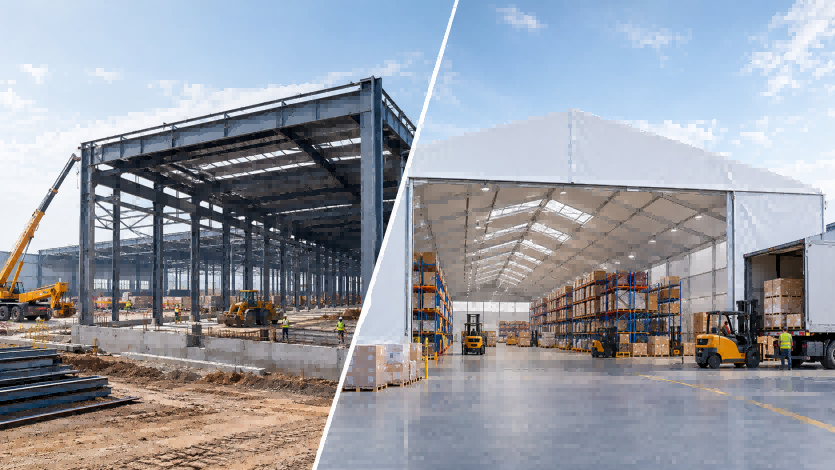
In the contemporary landscape of global logistics and manufacturing, supply chain resilience is a critical survival metric. Enterprise decision-makers are increasingly confronted with a strategic dilemma when facing capacity constraints: should they invest heavily in permanent, traditional brick-and-mortar warehouses, or pivot toward modular, aluminum-frame warehouse tents?
This comprehensive guide provides a rigorous, data-driven cost analysis and operational evaluation of both methodologies. By examining Capital Expenditure (CAPEX), Operational Expenditure (OPEX), time-to-market metrics, and asset liquidity, we aim to equip procurement officers and logistics directors with empirical insights, highlighting how industry veterans like Changzhou Changyi Exhibition Tent Co., Ltd. (CY-Tent) are redefining industrial storage solutions.
Key Takeaways
Modular warehouse tents reduce initial CAPEX by 30% to 50% compared to traditional steel structures.
Deployment timelines shrink from 12-18 months to 3-6 weeks, capturing immediate ROI.
100% clear-span architecture maximizes effective usable volume, eliminating internal pillar dead zones.
Aluminum frames (6061-T6) offer a 20-year lifespan with virtually zero structural maintenance.
Tents act as liquid, relocatable assets, avoiding the sunk costs of permanent real estate.
CY-Tent provides OEM/ODM customization and 100% pre-delivery quality assurance.
Deconstructing CAPEX: Foundations, Materials, and Land
The most immediate point of comparison is the initial Capital Expenditure (CAPEX). A rigorous financial analysis reveals a stark divergence in cost structures, primarily driven by site preparation and material economics.
The Burden of Geotechnical Engineering
Traditional warehouses impose immense dead loads, requiring exhaustive geotechnical surveys, deep piling, and heavily reinforced concrete slab foundations. This earthwork alone can consume 20% to 30% of the total project budget. Conversely, a premium warehouse tent manufactured by CY-Tent utilizes a lightweight yet structurally robust aluminum alloy frame. If the site possesses a level asphalt or concrete surface, the tent can be securely anchored using heavy-duty expansion bolts, instantly reducing site preparation CAPEX by tens of thousands of dollars.
Material Procurement and Manufacturing Economies
Global structural steel pricing is notoriously volatile. Traditional steel warehouses require heavy I-beams and extensive on-site welding. In contrast, CY-Tent leverages its 2000-square-meter specialized factory floor and custom OEM/ODM services to utilize extruded aluminum alloys and high-tenacity PVC fabrics. These materials are precision-cut and pre-fitted in a controlled environment. This manufacturing efficiency ensures that the cost per square meter of a high-grade warehouse tent is typically 30% to 50% lower than that of a comparable traditional steel structure.
Cost Factor | Traditional Steel Warehouse | CY-Tent Modular Warehouse Tent |
|---|---|---|
Foundation | Deep excavation, rebar, thick concrete (High Cost) | Surface-level anchors on existing asphalt/concrete (Low Cost) |
Material Volatility | Subject to global steel tariffs and energy costs | Optimized extruded aluminum & PVC factory production |
Labor & Equipment | Heavy cranes, certified welders, months of labor | Small crew, bolted connections, days of labor |
The Hidden Killer of ROI: Time-to-Value and Permitting
In financial modeling, the Net Present Value (NPV) of a capital project is heavily penalized by delayed revenue generation. Erecting a traditional warehouse requires navigating a bureaucratic labyrinth of zoning approvals and environmental assessments, often taking 12 to 24 months before construction even begins.
The "Temporary Structure" Advantage
Modular warehouse tents are frequently classified by local zoning boards as "temporary" or "semi-permanent" structures, bypassing the most onerous building permits. Coupled with CY-Tent's pre-engineered modular nodes, the deployment timeline is compressed from years to weeks. With technical guidance provided by CY-Tent’s professional installation teams, a 5,000-square-meter warehouse tent can be fully erected and commissioned in 20 to 30 days. This rapid deployment allows enterprises to capture immediate ROI, securing inventory while competitors wait for municipal permits.
Spatial Ergonomics: The Economics of Clear-Span Architecture
The true measure of a warehouse is its "Effective Usable Volume." Traditional steel structures necessitate internal load-bearing columns, which disrupt material handling equipment and create "dead zones," reducing effective storage capacity by 10% to 15%.
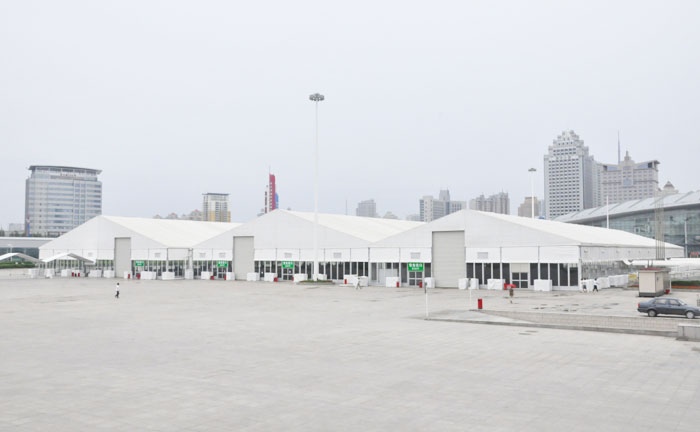
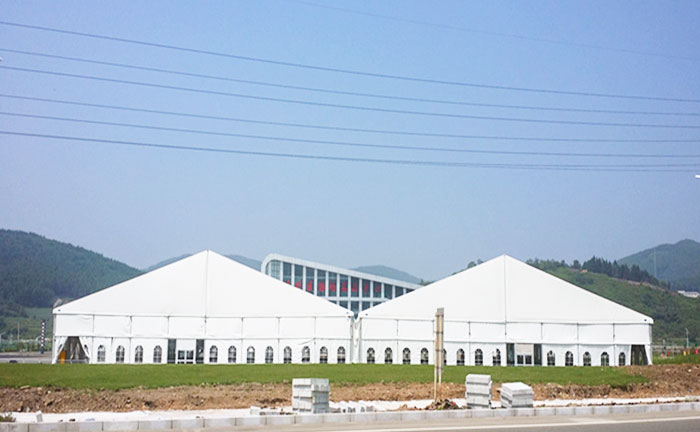
Warehouse tents are inherently designed around clear-span architecture. Utilizing advanced structural mechanics, CY-Tent engineers clear spans ranging from 10 meters up to 60 meters with absolutely zero internal pillars. This 100% unobstructed floor space allows logistics managers to implement high-density VNA (Very Narrow Aisle) racking and AGV pathways, maximizing the cubic volume of the facility and enhancing workplace safety. Beyond logistics, this versatile clear-span aluminum architecture is also highly sought after for constructing large-scale indoor sports facilities, providing unobstructed airspace for tennis, football, and swimming venues.
OPEX and the Maintenance Paradigm
A rigorous Total Cost of Ownership (TCO) analysis must encompass ongoing Operational Expenditure (OPEX). Traditional steel warehouses are susceptible to rust and require periodic sandblasting and repainting. Complex roof systems are prone to leaking, requiring constant maintenance.
The Zero-Maintenance Aluminum Matrix
Aluminum forms a self-healing oxide layer, making it inherently impervious to rust. The aluminum frames of a CY-Tent warehouse tent require virtually zero structural maintenance over their 20-year lifespan. Furthermore, the double-coated PVC fabrics (850g/m² to 900g/m²) feature UV inhibitors and self-cleaning coatings. Rain naturally washes away dust, eliminating manual washing costs while providing superior waterproofing.
Thermodynamics and Climate Control
For temperature-sensitive goods, CY-Tent offers advanced OEM/ODM thermal solutions, including insulated sandwich panels or inflated double-layer roof membranes. Additionally, the translucent nature of certain PVC roof membranes allows for significant natural daylight harvesting, deferring the massive electrical OPEX associated with high-bay LED lighting systems.
Asset Liquidity, Depreciation, and Relocatability
Traditional warehouses are illiquid, fixed real estate assets. If a lease expires, the warehouse becomes a stranded asset, and demolition costs are high. A warehouse tent is a modular, demountable asset. It is bolted together, not welded. If a business needs to relocate, the CY-Tent warehouse can be systematically dismantled, packed into shipping containers, and re-erected at a new location.
This relocatability fundamentally alters the depreciation model. It retains a high residual value on the secondary market. For multinational corporations or project-based contractors, the ability to deploy a massive storage facility for a three-year project, and then relocate it, represents an unparalleled return on investment.
Engineering Integrity, Safety, and Global Compliance
The modern industrial tent industry is governed by rigorous international engineering standards. CY-Tent employs dedicated R&D teams utilizing Finite Element Analysis (FEA) software. Structures are routinely engineered to withstand wind loads exceeding 100 km/h to 120 km/h and massive snow loads. The PVC fabrics meet stringent international fire-retardant standards (DIN 4102 B1, M2, NFPA 701), self-extinguishing in the event of a fire. All components are backed by our comprehensive quality assurance system, guaranteeing 100% compliance with international safety standards before dispatch.
The ESG Advantage
Modular warehouse tents represent a highly sustainable alternative. The installation process is a "dry build," requiring no cement, preserving topsoil, and minimizing the carbon footprint. Aluminum is infinitely recyclable, retaining nearly 100% of its material value at the end of its lifecycle, contributing positively to corporate ESG reports.
Strategic Decision Matrix: When to Choose Which?
The dichotomy is no longer "permanent versus temporary," but "rigid versus agile." Use the matrix below to guide your infrastructure investment.
Business Scenario | Traditional Construction | CY-Tent Warehouse Tent |
|---|---|---|
Land Ownership | Own land outright, permanent zoning | Leased land, temporary/semi-permanent zoning |
Time Horizon | 10 to 30+ year fixed hub | 1 to 10 years, scalable or relocatable |
Capital Strategy | Build equity, heavy debt servicing | Preserve liquidity, equipment depreciation |
Urgency | Low (12-24 months lead time) | High (Operational in 3-6 weeks) |
Conclusion & The CY-Tent Advantage
In an era where supply chain fluidity dictates market dominance, the financial and operational arguments heavily favor the adoption of high-grade aluminum warehouse tents for expansion, overflow, and mid-term storage. The drastic reductions in CAPEX, the elimination of bureaucratic delays, and the preservation of asset liquidity present an overwhelmingly compelling business case.
However, realizing these benefits requires a reliable manufacturing partner. With a legacy dating back to 2006, Changzhou Changyi Exhibition Tent Co., Ltd. (CY-Tent) combines the raw manufacturing power of a 2000-square-meter specialized facility with bespoke OEM/ODM capabilities. Their commitment to 100% pre-delivery quality assurance and expert technical guidance mitigates the risks associated with international procurement. Partnering with CY-Tent is a strategic investment in supply chain resilience and operational supremacy.
Your decision hinges on agility versus permanence. For temporary, seasonal, or rapidly changing needs, an industrial warehouse tent excels. List your top priorities—budget, timeline, and flexibility—and let that guide your choice.
If speed, cost savings, and asset liquidity matter most, a modular warehouse tent from CY-Tent is your optimal solution for 2026 and beyond.
Ready to Optimize Your Supply Chain Infrastructure?
Stop losing market share to construction delays or bleeding capital on short-term leases. Contact Changyi (CY-Tent) today for a free structural analysis, 3D engineering design, and a rapid quote tailored to your site conditions.
Get Your Free 3D Design & Quote ➔FAQ
How much does a warehouse tent cost compared to a traditional steel warehouse?
A professional aluminum-frame warehouse tent typically costs 30% to 50% less per square meter than a traditional pre-engineered metal building. These savings are primarily driven by the elimination of deep concrete foundations, reduced heavy machinery requirements, and streamlined labor costs.
What is the typical lifespan of a CY-Tent warehouse structure?
The extruded 6061-T6 aluminum frame is 100% rust-proof and designed to last 20 to 30 years with virtually zero structural maintenance. The high-grade PVC fabric membrane typically provides 8 to 10 years of service before requiring replacement, which is a fraction of the cost of replacing a roof on a traditional building.
Can a modular warehouse tent withstand severe weather conditions?
Yes. CY-Tent engineers structures using Finite Element Analysis (FEA) tailored to local meteorological data. Standard industrial tents are rated to withstand wind loads of 100-120 km/h and significant snow loads. The aerodynamic curved roof design naturally sheds snow and deflects wind, ensuring structural integrity.
Is it difficult to get building permits for a warehouse tent?
In many jurisdictions, modular warehouse tents are classified as "temporary" or "semi-permanent" structures, which often exempts them from the lengthy and expensive permitting processes required for permanent brick-and-mortar or steel buildings. CY-Tent can provide structural calculation drawings to assist with local PE stamping and approval.
What happens if my business needs to relocate or expand?
Unlike traditional real estate, a warehouse tent is a liquid, demountable asset. It can be systematically dismantled, transported in standard shipping containers, and re-erected at a new location. Furthermore, the modular bay design allows you to easily expand the facility's length as your business grows.